 Stampario
EPA refrigerant service record and leak rate
Since January 1, 2026, EPA’s HFC leak-repair rule (40 CFR 84.106) requires the technician to give the owner a service record after installing, servicing, repairing or disposing of an appliance with 15 lb or more of an HFC or substitute refrigerant. It lists the appliance, the date, who did the work, the refrigerant type and amount added, the full charge, and the leak rate with the method used. Owners keep these records for 3 years.
Which equipment it covers
The rule covers appliances with a full charge of 15 lb or more of an HFC or substitute refrigerant with a GWP above 53: commercial refrigeration, industrial process refrigeration and comfort cooling of that size. It does not reach typical residential split systems. Older ozone-depleting refrigerants such as R-22 fall under the separate Section 608 records in 40 CFR 82.
What the service record must contain
- The appliance (an ID the owner can match)
- The date of the service
- The name of the person who did the work
- Refrigerant type and the amount added (or removed at disposal)
- The full charge of the appliance
- The leak rate and the method used to calculate it
How the leak rate is calculated
With the annualizing method, the leak rate is the refrigerant added divided by the full charge, multiplied by 365 divided by the days since the last addition (365 if longer), times 100. Example: 4.5 lb added to a 28 lb system 120 days after the last top-up is 4.5 ÷ 28 × 365 ÷ 120 × 100 ≈ 48.9%.
Retention and reporting
Owners keep the records for 3 years. Appliances that leak 125% or more of their full charge in a calendar year are reported to EPA by March 1 of the following year.
How Stampario fills it
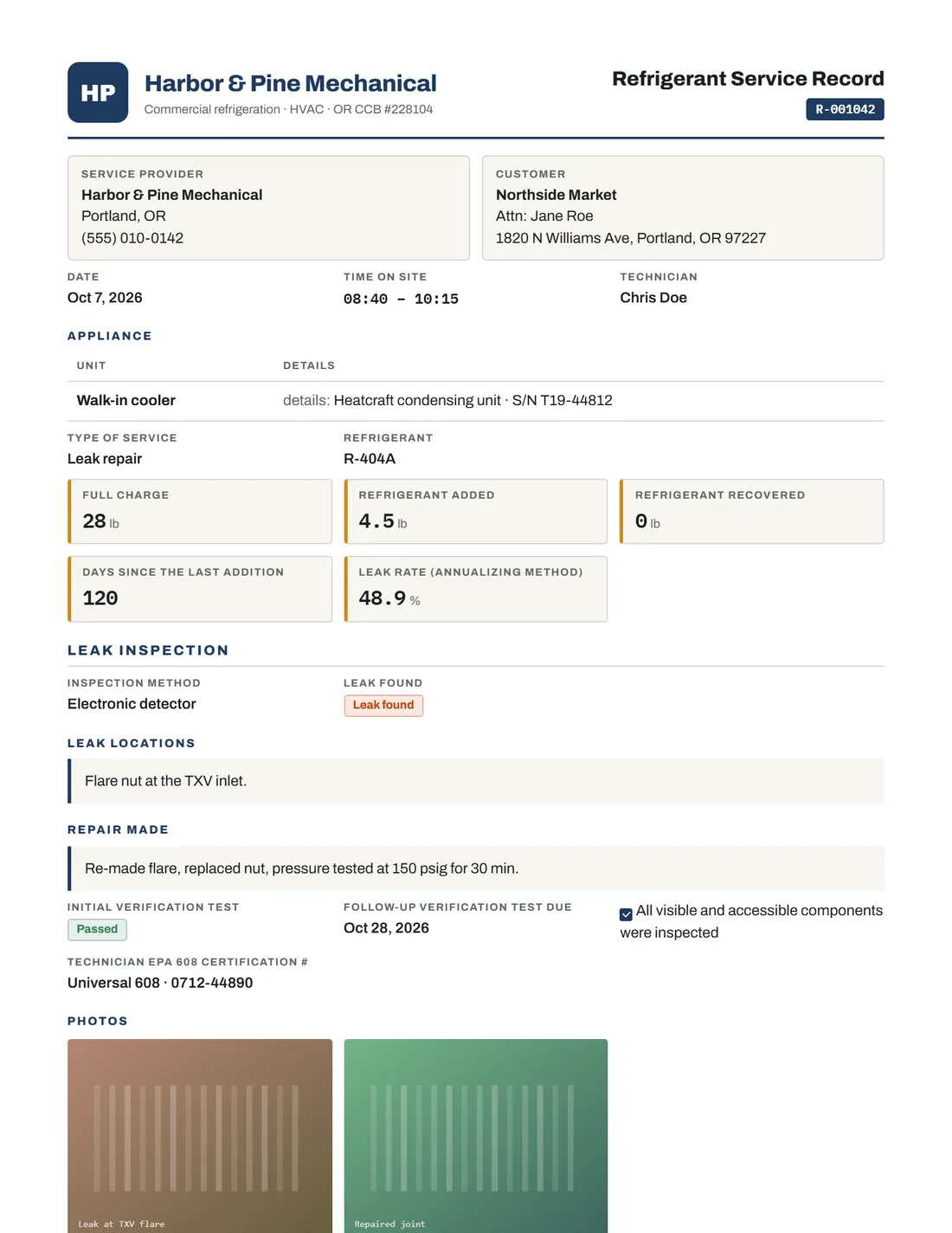
- The refrigerant service record calculates the leak rate as you type the amount added, the full charge and the days since the last addition.
- Leak locations, repair, verification tests and your 608 certification number go on the same PDF the owner receives.
- Every appliance keeps its history at the address, so the date of the last addition is right there.
Common questions
Is the annualizing method the only method?
No. The rule also allows a rolling-average method. Write the method you used on the record; the template prints "annualizing method" next to the calculated rate.
Who keeps the record, the contractor or the owner?
The technician gives it to the owner, and the owner keeps it for 3 years. Keeping your own copy in the app is how you answer the next "when did you last add refrigerant?" question.
Sources
- 40 CFR 84.106, leak repair for appliances with HFC or substitute refrigerants (Cornell LII)
- 40 CFR 82.166, Section 608 recordkeeping (Cornell LII)
Codes change by edition and the authority having jurisdiction (your fire marshal, water purveyor or state agency) decides which rules apply. This page is general information, not legal advice.