 Stampario
Denver Water backflow test report
Denver Water requires a backflow prevention assembly to be tested on installation and every year after, by a certified tester. Domestic and irrigation assemblies can be tested by a tester holding an ABPA or ASSE certification; fire assemblies also need a Colorado Fire Suppression System Contractor-Backflow certification. Test reports go to Denver Water’s Cross-Connection Control office by email (preferred) or mail. A new assembly must be tested within 48 hours of installation.
Deadlines
- New installation: test within 48 hours of installation and send the report to Denver Water
- Every year after that. Irrigation assemblies are tested in the May to September season, and Denver Water sends a reminder 30 days before the annual test is due
- After a failed cross-connection survey: install an approved assembly within 60 days of the survey; a longer period needs Cross-Connection Control approval
- Denver Water sends three notices before a disconnection within a 60-day period; a $250 penalty applies from May 1, 2025 when three mailed notices go unanswered and the service goes into suspension status
- Denver Water’s pages do not give a number of days for submitting a routine annual test report
Who can test
After Colorado HB25-1077, domestic and irrigation assemblies can again be tested, inspected and repaired by a certified tester holding an ABPA or ASSE certification, and plumbing licensure is not required. Fire assemblies need an additional certification from the State of Colorado as a Fire Suppression System Contractor-Backflow to be accepted by Denver Water.
Where reports go
All testing must be reported to Denver Water’s Cross-Connection Control office. Email the report to crossconnectioncontrol@denverwater.org (preferred), or mail it to Attn: Cross-Connection Control, 1600 W 12th Ave, Denver, CO 80204. The pages read for this guide name no tester portal. The office phone is 303-628-5969.
The report form
Denver Water publishes a Denver Water Test Report Form for testers. This guide does not list its fields because the PDF could not be read as text; use the current form from the Denver Water page.
Rules cited
Denver Water cites CDPHE Regulation 11 (section 11.39), its Engineering Standards chapter 5.05 and its Operating Rules chapter 11.
How Stampario fills it
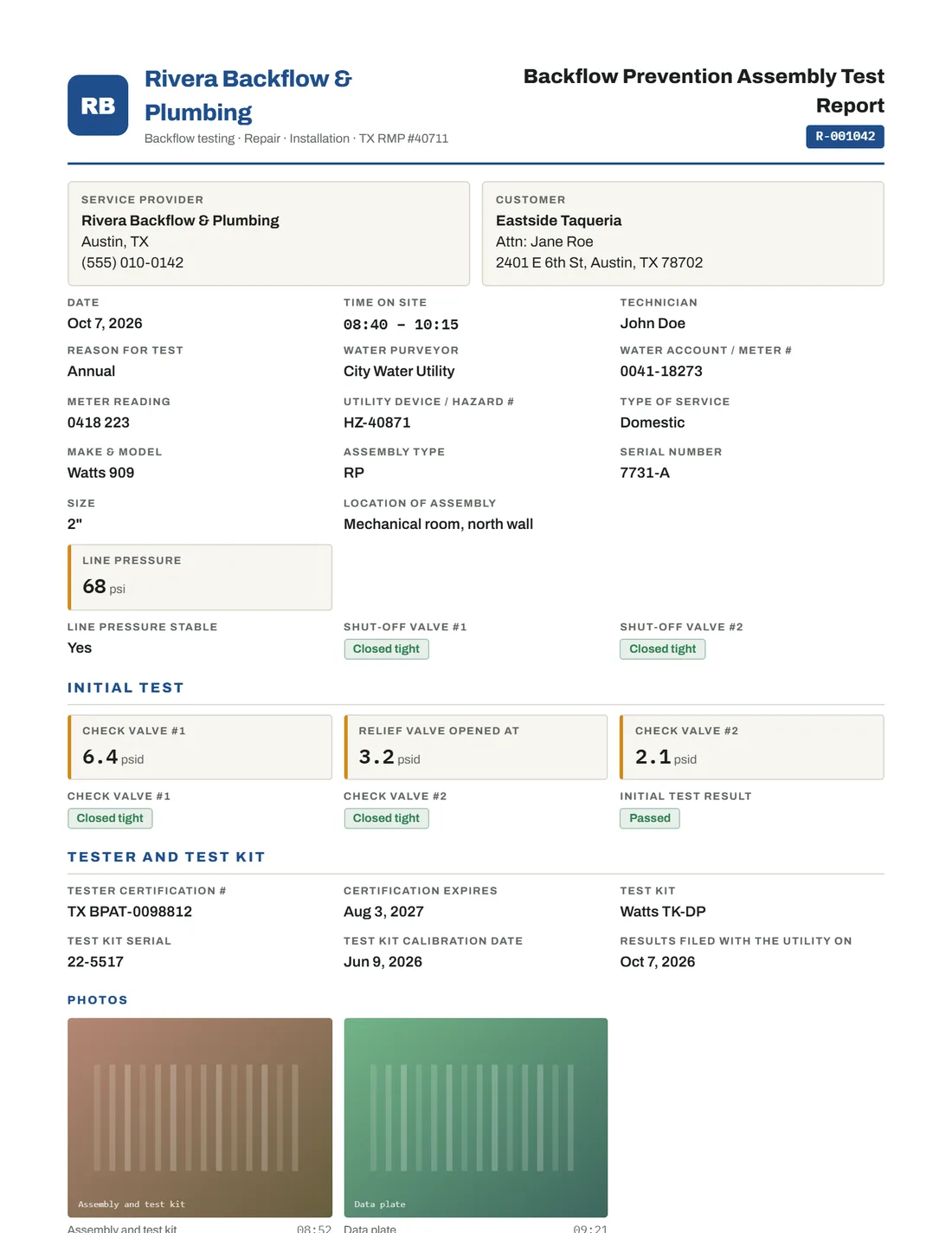
- The standard backflow report records assembly make, model, serial, size and location, the check valve and relief valve readings, repairs, the retest, the test kit and its calibration date, and the tester’s certification.
- A completed report is a PDF, so emailing it to the Cross-Connection Control office takes one tap on site.
- The test date and the installation date are on the report, so the 48-hour rule for new assemblies is easy to prove.
Common questions
Can I email a PDF report to Denver Water?
Yes. Denver Water’s page says test reports can be emailed, which it prefers, or mailed, to the Cross-Connection Control office.
Does a tester need a plumbing license in Denver?
Denver Water’s page says that after HB25-1077 plumbing licensure is not required for domestic and irrigation work by a certified ABPA or ASSE tester. Fire assemblies need the extra Colorado Fire Suppression System Contractor-Backflow certification.
More backflow guides
Who the report goes to, the deadline and how it is filed differ by utility. Each guide names the rule and links the source.
Sources
- Denver Water: Backflow Prevention Program
- Denver Water: Cross-Connection Control Survey
- Colorado HB25-1077
- CDPHE: Regulation 11, Colorado Primary Drinking Water Regulations
Codes change by edition and the authority having jurisdiction (your fire marshal, water purveyor or state agency) decides which rules apply. This page is general information, not legal advice.