 Stampario
NYC DEP backflow test report (GEN215B)
New York City DEP uses one form, GEN215B (rev. 1/2019), “Report on Test and Maintenance of Containment Backflow Prevention Assembly”, for the initial and the annual test, one form per assembly. A New York State certified backflow tester completes Parts A and B. Initial tests also need Part C (a State licensed Professional Engineer or Registered Architect) and Part D (a NYC Licensed Master Plumber). The form says to send one completed form within 30 days of installation and initial testing, with original ink signatures and seals, to the DEP Cross-Connection Control Unit in Flushing.
Who completes what
- Part A, for every test: public water supply, county, block and lot, facility name and address, make and model, size and serial number, and location (floor) of the assembly
- Part B, by the NYS certified tester, for every test: test before repair, repairs, final test, line pressure, pressure drop across the first check valve, check valve 1 and 2 leak or closed tight, relief valve opening (RPZ only), water meter number and reading, completion time, type of service (domestic, fire, combined, IWM)
- Part B also asks whether there are any connections between the point of entry and the assembly, or other deficiencies, and has two certifications: the assembly meets the requirements of an acceptable containment assembly at the time of testing, or it does NOT meet them; signature, date, name, phone, certified tester number and expiration
- Part C, initial test only: NYS Professional Engineer or Registered Architect, with the DEP backflow assembly approval number, whether designer of record, and minor installation changes
- Part D, initial test only: NYC Licensed Master Plumber, with the Department of Buildings number, licence number and signature and seal
Deadlines and filing
- Initial test: complete all four parts and send one form within 30 days of installation and initial testing
- Annual test: the form is headed “For the Year ____” and says to complete Parts A and B only
- Mail one completed form to NYC-DEP-BWSO, Cross-Connection Control Unit, 59-17 Junction Blvd., 3rd Fl. Low-Rise, Flushing, NY 11373 (the instructions give 11373-5108)
- The form asks for original ink signatures and original ink or raised-impression seals, and says the engineer or architect, master plumber and tester sign the same form for each assembly
- The form does not give a due date for the annual report, an email address or a portal
What the form does not say
The form and instructions read for this guide give no retest deadline after a failed test and do not say how long the report must be kept. The instructions refer to the “New York City Cross-Connection Control Program Handbook” on the DEP site. The Handbook, the DEP web pages and the City rules were not read for this guide (nyc.gov rule pages returned errors to our fetcher), so check them for the annual due date.
How Stampario fills it
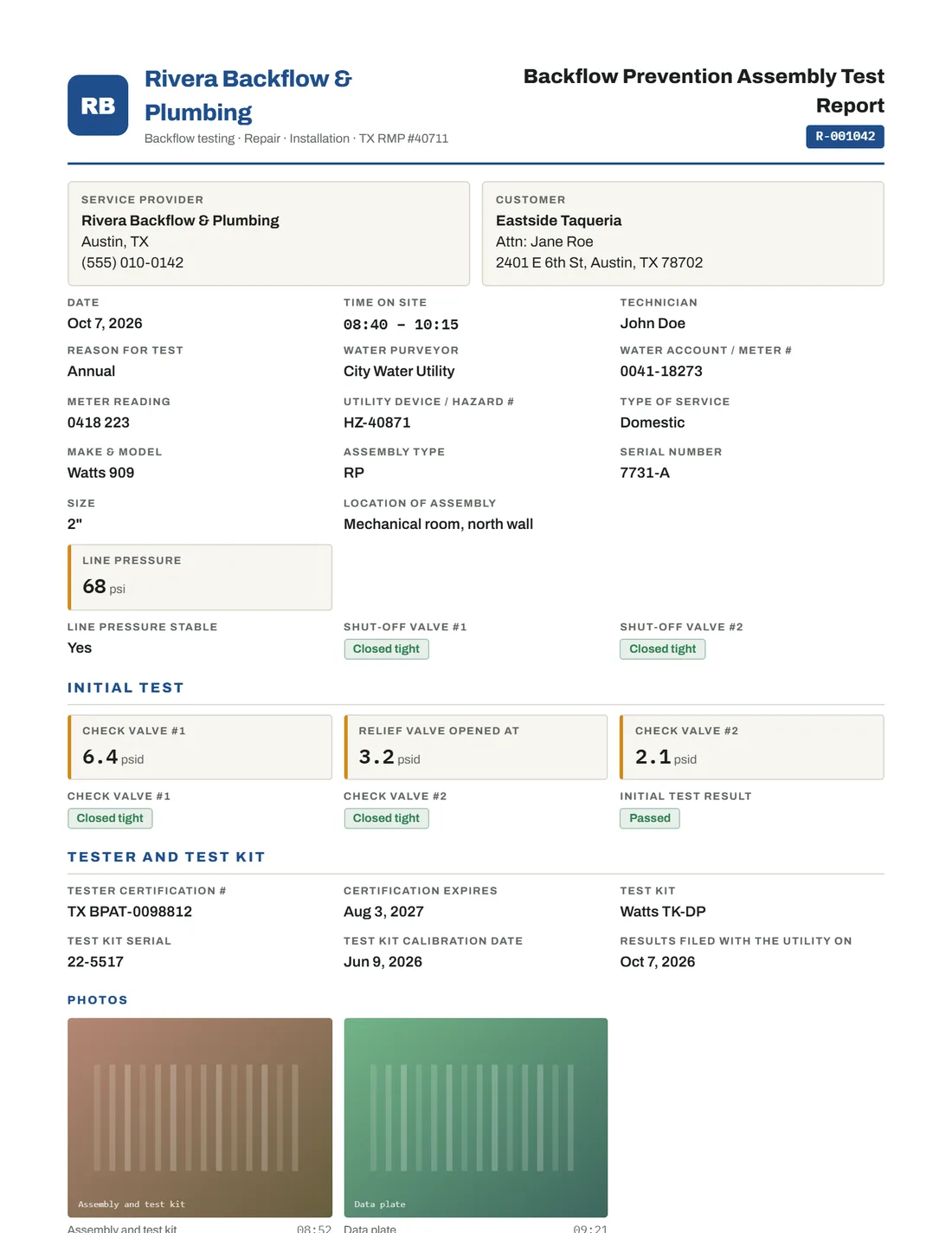
- The standard backflow report holds the Part A and Part B values: make and model, serial, size, location, line pressure, check valve readings, relief valve opening, meter reading, type of service, repairs, the retest, and the tester certification number and expiration date.
- It does not have block and lot, completion time, the connections question, or the engineer or master plumber certifications and seals in Parts C and D. Put the Part B extras in the notes. Parts C and D still need ink signatures and seals on the DEP form.
- Use the report as your own signed record of the test and for the customer; the DEP form is what the Cross-Connection Control Unit asks for.
Common questions
Does an annual NYC DEP test need a Professional Engineer?
According to the form, no: for an annual test complete Parts A and B only. Parts C and D are for the initial test.
Can I email the form to DEP?
The form asks for one completed form with original ink signatures and seals, mailed to the Cross-Connection Control Unit. It names no email address.
More backflow guides
Who the report goes to, the deadline and how it is filed differ by utility. Each guide names the rule and links the source.
Sources
Codes change by edition and the authority having jurisdiction (your fire marshal, water purveyor or state agency) decides which rules apply. This page is general information, not legal advice.