 Stampario
Phoenix backflow test report
Phoenix requires backflow assemblies to be tested at installation, after repair or relocation, and at least once a year, by a certified tester who is on the City’s list. The City’s technical guideline (issued 6/30/2025) says the tester sends the original test report to Planning and Development, Cross-Connection Control, within 10 days of each test for containment (City Code Chapter 37) assemblies, on a City report form (TRT/DOC/00337, rev. 7/25). Reports go in by email or mail. The customer keeps records for at least three years.
Deadlines
- Test at installation, at repair, alteration or relocation, at least annually, and when the City requests it (for example after a backflow incident)
- For containment assemblies required by City Code Chapter 37, the guideline’s table says the tester sends the original report to P&D Cross-Connection Control within 10 days of each test. The table does not mark that row for point-of-use assemblies required only by the plumbing code
- The guideline also says the report must reach P&D by the due date on the work order
- The customer keeps records for at least three years from the test date
- The pages read for this guide give no repair or retest deadline after a failed test
Where reports go
- Email Backflow.Prevention@phoenix.gov, or mail City of Phoenix, Backflow Prevention Program, 438 West Adams Street, Phoenix, Arizona 85003
- Phone 602-534-2140
- For assemblies on a fire line or fire sprinkler system the table also has a copy going to the Phoenix Fire Department Fire Prevention Division, and testing downstream of a fire line backflow preventer is the Fire Department’s responsibility
What the City form asks for
- Water purveyor, water meter number and permit number (for a new or replacement assembly)
- Manufacturer, size, model and serial number; management company and owner with contacts; assembly address, business at the location and on-site location
- New or replacement (and the replaced serial number); purpose (secondary or primary) and system (fire, landscape, potable); type (SVB, PVB, DC, RP, other); line pressure and back pressure
- Initial test readings, repairs with part numbers, and a final test
- Test company name, address and phone; initial test, repair and final test by name with certified tester number, dates and test kit serial number
- For a fire sprinkler assembly: the alarm company or Fire Department notified, with contact, time and date, and when the system was out of service and restored (in the comments)
Who can test
The guideline says testing is done by a tester who has met City requirements and is on its list of certified testers. Companies provide the tester competency certification, the annual gauge calibration report, an Arizona contractor’s license (not required for a company that only tests backflow preventers and does no permit work) and a City of Phoenix privilege license. “Certified” means certified by ASSE Series 5000, the ASETT Center, ABPA or another entity the Arizona Department of Environmental Quality has approved. Tests follow the Ninth Edition USC Manual of Cross-Connection Control.
Test gauge
No gauge may be used unless it passed a valid calibration test within the 12 months before the date on the test report. The City wants an original calibration report for each gauge, showing the calibration company, who did it, the gauge make, model and serial number, the owner, the date and the test standards used.
Incomplete reports
The City’s instructions say reports lacking information or with inaccurate information are returned to the tester for correction, and the owner is told that the backflow certification for the assembly is not acceptable for the stated reasons. That is the City’s wording; it does not say what happens to a deadline in the meantime.
Rules cited
The guideline cites the 2024 Uniform Plumbing Code sections 602 and 603, Phoenix City Code section 37-143 and Arizona Administrative Code R18-4-215. Subsection F of R18-4-215 requires that an assembly be tested at least annually, that testing be done by a certified general tester, and that no assembly be placed in service until it has been tested and works as designed (rule text read on Cornell LII; the Arizona Secretary of State’s copy was not read).
How Stampario fills it
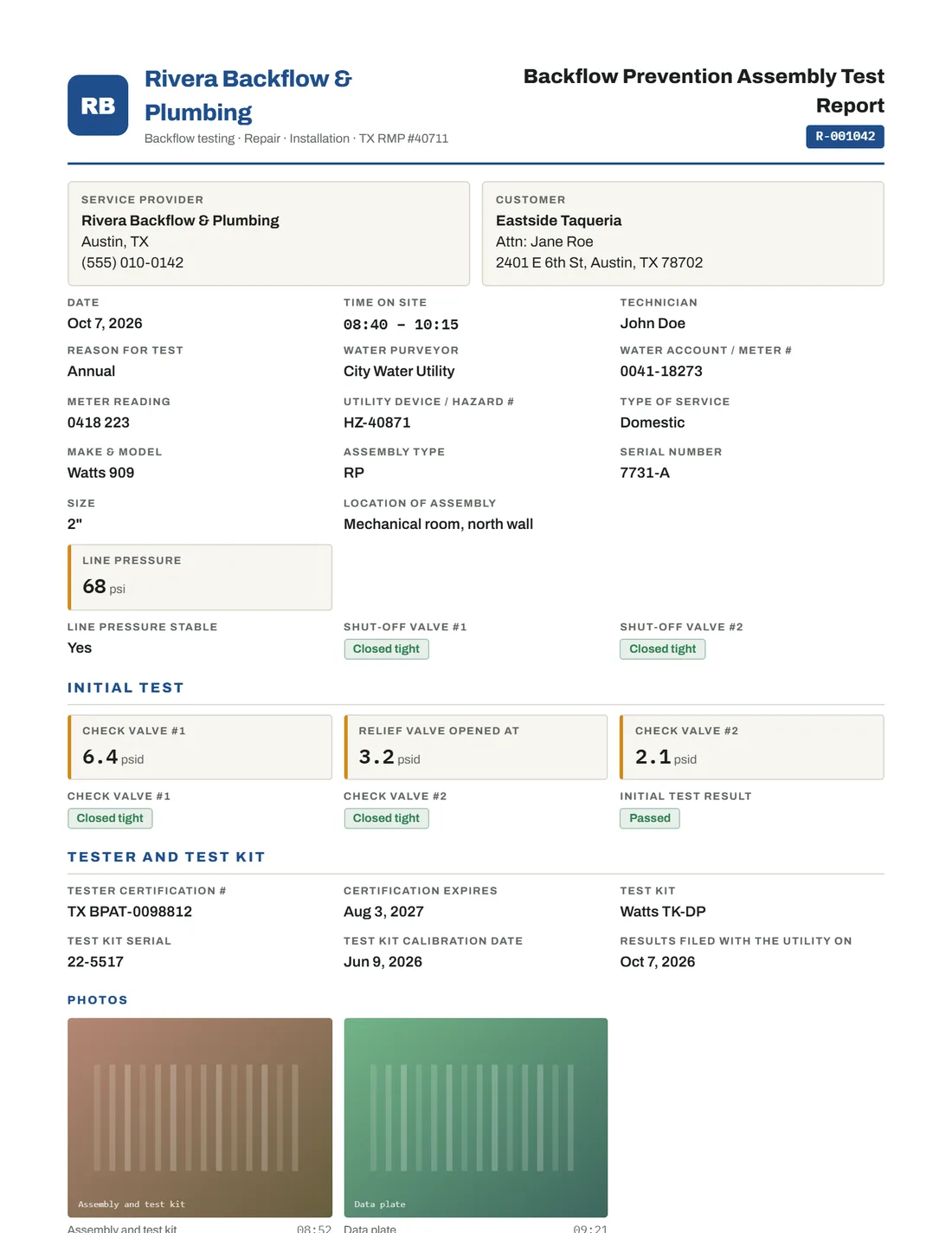
- The standard backflow report holds the City form’s core values: water purveyor, meter number, new or replacement and the replaced serial number, make and model, assembly type (SVB, PVB, DC, RP), serial, size, location, line pressure, check valve and relief valve readings, repairs, the retest, and the tester certification number.
- It records the test kit make and serial number and the calibration date, so the 12-month gauge rule is visible on every report.
- It does not have fields for the management company, owner contacts, back pressure or the fire alarm notification; put those in the notes or copy the values onto the City form.
- The test date and a separate filing date are on the report, so the 10 days are easy to check before you email it to the Backflow Prevention Program.
Common questions
Does Phoenix have its own backflow test report form?
Yes. The City publishes a Backflow Prevention Assembly Test Report (TRT/DOC/00337, rev. 7/25) and says the report goes on a City form. Your own signed report is a record; file the City’s form for the City.
Can I email the report?
Yes. The City’s instructions say to email reports to Backflow.Prevention@phoenix.gov or mail them to the Backflow Prevention Program.
More backflow guides
Who the report goes to, the deadline and how it is filed differ by utility. Each guide names the rule and links the source.
Sources
- City of Phoenix: Backflow Tester Requirements, Customer Responsibilities (TRT/DOC/00636, rev. 7/25)
- City of Phoenix: Backflow Prevention Assembly Test Report (TRT/DOC/00337, rev. 7/25)
- City of Phoenix: Backflow Assembly Test Report Instructions (TRT/DOC/00335, rev. 7/25)
- Arizona Administrative Code R18-4-215, Backflow Prevention (Cornell LII)
Codes change by edition and the authority having jurisdiction (your fire marshal, water purveyor or state agency) decides which rules apply. This page is general information, not legal advice.