 Stampario
Miami-Dade backflow test report form (WASD)
In Miami-Dade County, the Water and Sewer Department (WASD) requires certain backflow prevention assemblies to be tested on installation and every year by a certified tester. Results go to WASD through its online test portal, or on the county’s Backflow Prevention Assembly Test Report Form. The form has four numbered sections (owner and device address, tester, test kit, assembly), then the test, repairs and retest. It must be filled in completely: incomplete forms are returned.
What the form asks for
- Section 1: address of the device, owner, owner contact, phone, fax, owner’s address and ZIP
- Section 2: tester name, certification number and expiration date, business name and address
- Section 3: test kit make, model, serial number, date last calibrated, and whether a sight tube was used
- Section 4: assembly make, model, serial, size and type (RP, DC or PVB), location, hazard or service, meter number and reading, date of test, initial or annual test
- Shut-off valves 1 and 2 closed tight or leaked, line pressure and whether it was stable
- The test: each check valve closed tight or leaked with the pressure differential; the relief valve failed to open or opened at; the PVB air inlet and check
- If the assembly fails: reason for failure, parts cleaned or replaced, and a retest in the same grid
- A certification that the test followed the AWWA Cross Connection Control Manual, the tester’s signature and date
Filing online
WASD gives each tester a username and password for its online test reporting site. Testers find the assembly by serial number and house number, or by the hazard number printed at the top of the county’s test report form, confirm or correct the details, enter the initial test (pass or fail, date, values), any repairs and the final test, pick the test kit and check the required statements. The site can print a completed report for the customer and a receipt.
Who can test
A certified tester completes a 40-hour course in backflow assembly testing and passes a proficiency test. To be listed with WASD, a company sends the tester information form with copies of its business license, liability insurance, test kit calibration certificate, tester certificates and contractor licenses. WASD does not endorse testers.
How often
WASD’s page says certain assemblies are tested on installation and every year. Florida rule 62-555.360 sets at least yearly tests at non-residential connections and at least every 2 years at residential ones.
How Stampario fills it
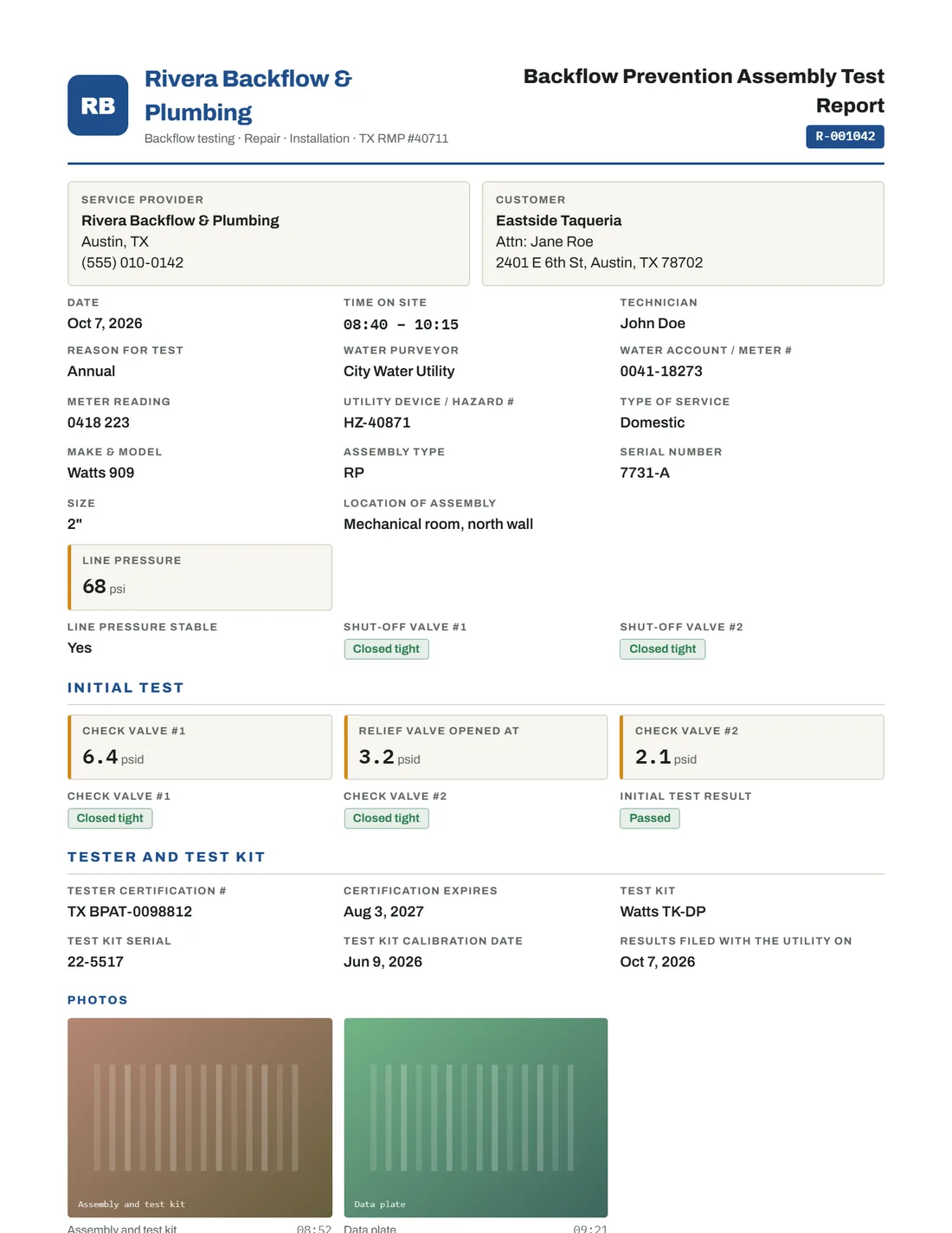
- The standard backflow report records the form’s values: tester certification and expiry, test kit and calibration date, assembly details, meter number and reading, shut-off valves, line pressure and whether it held stable, readings, repairs and the retest.
- A "Utility device / hazard #" field holds the hazard number from the county’s form, the number the portal searches by.
- A "filed with the utility on" date records when you submitted the test online.
Common questions
Will WASD take a Stampario PDF instead of its form?
WASD asks for its form or its online portal, and returns incomplete forms. File with one of those. The Stampario report is the owner’s signed copy and your record, with the same values ready to type in.
Which version of the form is current?
The county’s page links a 2010 revision; a 05/12/2026 revision with the same fields and the newer Backflow@miamidade.gov address is also on the county site. Check the county page before you print a stack.
Sources
- Miami-Dade WASD: Cross-Connection Control and Backflow Prevention
- Miami-Dade WASD: Backflow Prevention Assembly Test Report Form (rev. 05/12/2026)
- Miami-Dade WASD: Web test reporting for backflow testers
- Fla. Admin. Code R. 62-555.360, Cross-Connection Control (Cornell LII)
Codes change by edition and the authority having jurisdiction (your fire marshal, water purveyor or state agency) decides which rules apply. This page is general information, not legal advice.