 Stampario
Backflow test report for Canada (CSA B64.10)
Municipal backflow forms in Ontario, BC and Alberta share the CSA B64.10.1 readings: the check valve pressure drop (A), the relief valve opening point (B) and the buffer C = A − B. This report records all of them, works out the buffer for you, and has room for the owner’s signature many cities ask for.
Rather fill it on your phone? Try it free in Stampario: the customer signs on screen and gets the PDF before you leave.
What the report records
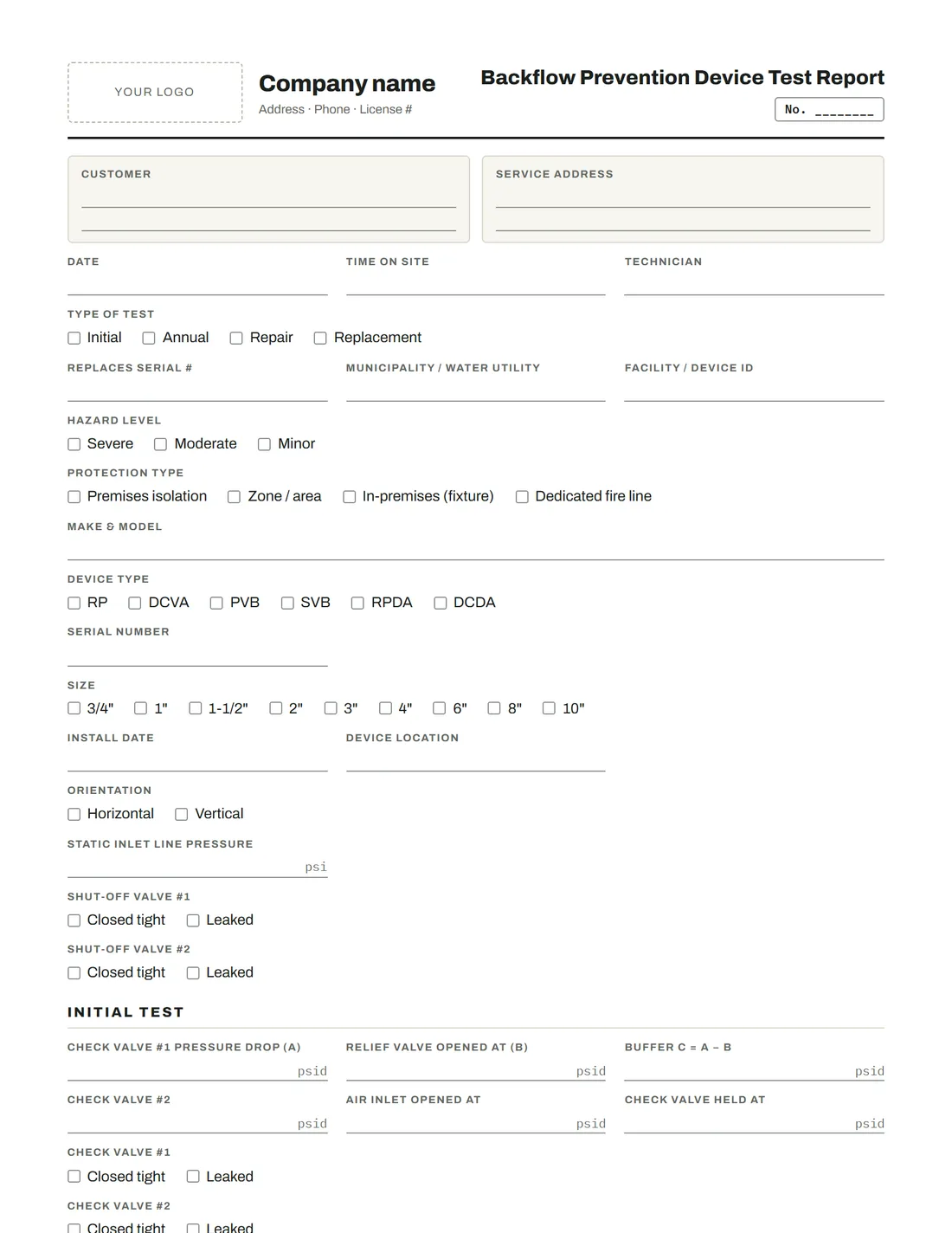
Type of test, municipality, facility or device ID, hazard level (severe, moderate or minor) and protection type. Then the device: make, model, type, serial, size, install date, location and orientation. The test covers static line pressure and both shut-off valves, then CV1 pressure drop (A), relief opening (B) and buffer C for RPs; check valve readings, spring tension loss and sight tube confirmation for DCVAs; and the air inlet and check for PVBs and SVBs. A failed test adds repairs and a re-test. It closes with your certifying body (OWWA, BCWWA or AWWA), certificate number, test kit calibration, and tester and owner signatures.
Deadlines differ by city
Toronto, Calgary, Edmonton and Vancouver each set their own submission window, from about 5 business days to 15 days, and several take reports only through a portal. Use your municipality’s form or portal for filing. This report is the customer’s signed copy and your own record, with the next annual test on your call list.
Built from the published forms
The field list comes from municipal forms published in Ontario and BC that follow CSA B64.10.1. It isn’t a municipal or CSA document, and the CSA standard itself isn’t reproduced.
- 01Type of test
- 02Replaces serial #
- 03Municipality / water utility
- 04Facility / device ID
- 05Hazard level
- 06Protection type
- 07Make & model
- 08Device type
- 09Serial number
- 10Size
- 11Install date
- 12Device location
- 13Orientation
- 14Static inlet line pressure
- 15Shut-off valve #1
- 16Shut-off valve #2
- 17Check valve #1 pressure drop (A)
- 18Relief valve opened at (B)
- 19Buffer C = A − B
- 20Check valve #2
- 21Air inlet opened at
- 22Check valve held at
- 23Check valve #1
- 24Check valve #2
- 25Relief valve failed to open
- 26Relief drain air gap meets code
- 27Spring tension loss
- 28Sight tube confirmation
- 29Air inlet opened fully
- 30Initial test result
- 31Repairs and parts
- 32Repair details
- 33Check valve #1 pressure drop (A)
- 34Relief valve opened at (B)
- 35Buffer C = A − B
- 36Check valve #2
- 37Air inlet opened at
- 38Check valve held at
- 39Re-test result
- 40Certified by
- 41Tester certificate #
- 42Certificate expires
- 43Test kit
- 44Test kit serial
- 45Last calibration
- 46Calibrated by
- 47Results filed with the utility on
- 48Remarks
Plus customer, service address, date, time on site, technician, photos and signatures.
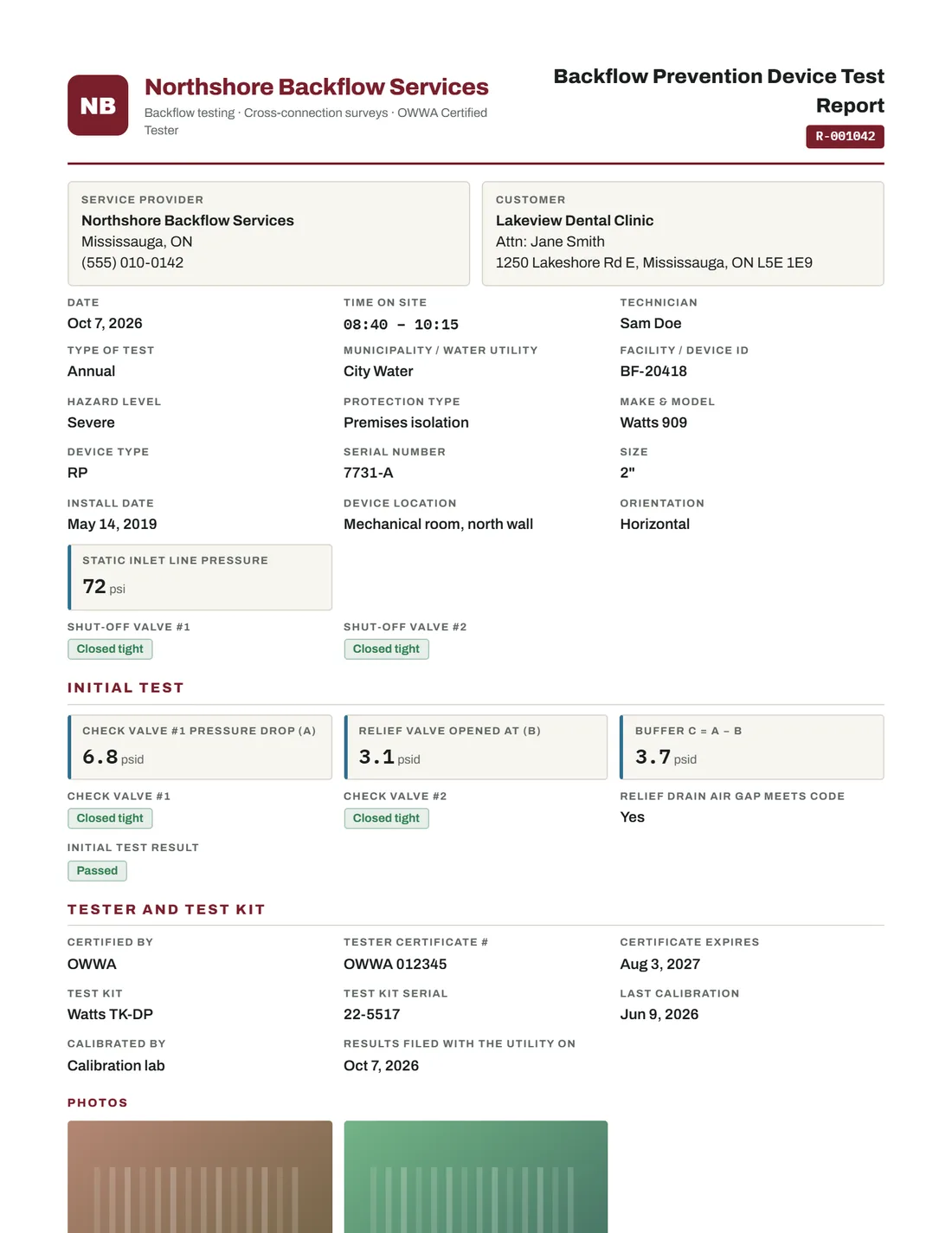
The same form, finished on site
- Last visit’s equipment details are already filled in
- Readings, photos and signatures on one PDF with your logo
- The customer gets it by email before you leave
- The next due date lands on your call list
About this template
Will my municipality accept this report?
Many require their own form or portal, so check with yours. This report contains the readings those forms ask for, which makes filing a copy-over job, and the owner gets a signed copy on site.
Does it calculate the buffer?
Yes. Enter the CV1 pressure drop (A) and the relief valve opening (B), and buffer C = A − B appears on the report, for the initial test and the re-test.
Can I use kPa?
Readings print in psi by default. You can rename a unit in your template, and a kPa option is planned for Canadian accounts.
Fill the canadian backflow test report (csa b64.10) on your phone
Free for 5 reports a month. No card. Your logo on every PDF from the first one.